He must increase, but I must decrease. John 3:30
This morning I would like us to consider one sentence from our Gospel reading today. It is that phrase spoken by St John the Baptist, ‘He must increase, but I must decrease’.
With many of the great saints there is often one phrase which describes their heroic virtue and which makes them a model for all Christians. And it seems to me that in the case of St John the Baptist we understand him best when we recall these words, ‘He must increase, but I must decrease’.
It is so with the Blessed Virgin Mary as well. In her case we recall the words, ‘Behold the handmaid of the Lord, let it be unto me according to your word’, and those other words which she spoke at the Wedding in Cana, ‘Whatever he says to you, do it’. She was the complete expression of these words, and becomes for us a model of how we should strive to live the Christian life.

Tuesday, 12 May 2015

Monday, 20 April 2015
Orthodox Catechesis - Session 1
Where is the best place to begin
a description of the Orthodox Christian life and faith? There are several
possibilities. Some have taken a theological perspective and have set out to
detail all of the different Orthodox doctrines or teachings of the Church.
Others have taken a more historical perspective and have described the
teachings of the Church as they became important in various controversies
through the early centuries. But this particular study and exploration of the
Orthodox Christian faith will root itself in the Bible, and will consider the
various teachings and practices of the Church through a brief overview of the
Scriptures themselves.
In the Orthodox Church all theological reflection (and theology means the study of God) is based on the Bible. Many of the arguments which arose in the Church about theology were actually to do with whether or not a particular teaching was considered to do justice to the words of the Scriptures. There has always been a tendency in Christian thinking for some to go beyond the words of the Bible and insist on their own rational and intellectual authority as being of greater weight than a prayerful reflection on the words of the Bible. But the Church has often reminded her members that we must begin and end our thinking about the Orthodox Christian faith with those things which God has revealed to us, and not with those things we reason out for ourselves.
Of course this does not mean that the Orthodox Christian faith and life is not reasonable, and is not based on real evidence that convinces those who respond to God with Faith. But God is not bound by our opinions, nor is he completely described by human words. He is always beyond everything we can say and reason about him. Therefore the proper approach to studying and exploring the Orthodox Christian faith is one of humility and prayerfulness, rather than one of intellectual curiosity. The Christian life is a relationship with God, and not an educational syllabus which must be completed.
When we ask what someone is like we do not normally want an answer that says, ‘He is 190 cm tall, weighs 65 kg, and has brown hair’. Such an answer would not tell us very much about the person at all. We usually mean, ‘what is he really like?’, meaning the person inside rather than the outward appearance. And so it should be with the study of the Orthodox Christian faith and life. Even an atheist could study the outward appearance of Orthodoxy, but they would not gain that inner experience which is what the Orthodox Christian Faith is really about. Nor would they have a grasp of the nature of the personal relationship with God which Orthodoxy teaches and offers to all who embrace the Christian life.
Therefore this exploration of the Orthodox Christian faith and life will contain practical exercises and opportunities for reflection. It is not enough to know things about God and about the Christian life, it must be experienced, and experienced by you, the person exploring our Orthodox life, otherwise the reality of our faith will not be known at all.
In the Gospel of St Luke our Lord Jesus Christ says,
Luke 11:9-10 So I say to you: Keep asking, and it will be given you. Keep searching, and you will find. Keep knocking, and the door will be opened for you. For everyone who keeps asking will receive, and the person who keeps searching will find, and the person who keeps knocking will have the door opened.
We believe, as Orthodox Christians, that this is our own experience. As we have asked for a knowledge of God we have received. As we have made every effort to find God he has revealed himself to us, and as we have knocked on the door with perseverance so God has opened the door of our heart and mind and has welcomed us into his presence.
Perhaps this all seems unlikely, or at least something that you do not expect to experience for yourself. Nevertheless, begin this journey into Orthodox with all the faith that you have, even if it is very small indeed, and let us see where God leads us. We have all of us to begin somewhere, so be encouraged to begin where you are. Indeed each of us, no matter how many years we have been Christians, must begin the journey again each day. The Christian life is a marathon rather than a sprint. It is more like a sponsored walk from Land’s End to John O’Groats than a gentle stroll on a Sunday afternoon. Those of us who have already begun this journey have not yet completed it, indeed we often struggle to keep moving forward. So we will be travelling together and your own questions, doubts, experiences and hopes will not be dissimilar to those of an Orthodox Christian who has been on the spiritual way for many years.
With faith and hope, the little faith and hope you have, begin the journey today as you must begin every day.
In the prayers for the making of a catechumen, (a person seeking instruction in the Orthodox faith), there is the prayer.
Almighty and everlasting God, the Father of our Lord Jesus Christ, mercifully look upon your servant whom you have chosen to call to the beginnings of the faith, and upon whom we have set your sign as a token of your good will and gracious purpose towards him. Deliver him, we beseech you, from all unholy and vain desires; remove from him all blindness of heart; instruct him in your holy mysteries; enable him to understand and embrace your truth; and speedily make him ready for the grace of your holy Baptism, and receive him unto the same: through the good will and grace of your Only-begotten Son, with whom, and with your all-holy, good and life-giving Spirit, you are blessed for ever.
This prayer expresses clearly the sense that we do not begin the journey having all the answers, or indeed being ready immediately to be received as a member of the Church. We believe that we are called by God to make a beginning, and the sign of the cross is made on the person who becomes a catechumen as a sign that they are starting out in the Christian life. This period of the catechumenate is provided so that there is time and space to come to a fuller understanding of the Christian life, and to choose it wholeheartedly for yourself. The Church continues to pray that all those who have entered the state of the catechumenate will be able to make the most of this time of exploration. It is a spiritual journey which is begun by the catechumen and not an intellectual or educational one, though of course there are many things to learn and understand.
There will be one part of this study issued each week, and each one will contain about the same amount of reflection on the Orthodox faith, and then a short exercise. This week I would like you to commit yourself to praying two prayers each day. You can of course pray them more frequently, and you may already pray one of them each day. But whether this is your practice or not I would like you to make every effort to pray these two prayers once each day.
The first prayer is the Lord’s Prayer. Our Lord Jesus taught his disciples this prayer himself and therefore it is one of the most important for all Orthodox Christians to know and pray regularly.
Our Father in heaven,
hallowed be your name.
Your kingdom come, your will be done,
on earth as it is in heaven.
Give us this day our daily bread,
and forgive us our debts,
as we also have forgiven our debtors.
And lead us not into temptation,
but deliver us from evil.
Through Jesus Christ our Lord.
And the second is a prayer from the book of prayers of the British Orthodox Church in the Coptic Orthodox Patriarchate. It has been chosen so that already you are able to unite your prayers with Orthodox Christians, but also because it expresses so well the attitude of the Orthodox Christian as he approaches God in prayer.
Have mercy on us, O God, and have mercy on us, who, at all times and in every hour, in heaven and on earth, is worshipped and glorified, Christ our God, the good, the long suffering, the abundant in mercy, and the great in compassion, who loves the righteous and has mercy on sinners of whom I am the chief; who does not wish the death of the sinner but rather that he repents and lives, who calls all to salvation for the promise of the blessings to come.
Lord receive from us our prayers in this hour and in every hour. Ease our life and guide us to fulfill Your commandments. Sanctify our spirits. Cleanse our bodies. Conduct our thoughts. Purify our intentions. Heal our diseases. Forgive our sins. Deliver us from every evil grief and distress of heart. Surround us by Your holy angels, that, by their camp, we may be guarded and guided, and attain the unity of faith, and the knowledge of Your imperceptible and infinite glory. For You are blessed forever. Amen.
Please make these prayers your own over this coming week. Turn your heart with faith and hope towards God, and reflect on what it is that you desire from this journey of exploration. The one who asks, seeks and knocks with perseverance will not be turned away.
May God bless our spiritual journey, however long we have been on the road, and bring us safely to his presence in the end.
To the glory of God, the Father, the Son, and the Holy Spirit. Amen.
Monday, 23 March 2015
Orthodox TV Programmes

I was very grateful for the opportunity to be able to record some programmes with CYC, TV and Aghapy TV in Cairo in January, thanks to the organisation of Father Daoud Lamie and the excellent Marina Wagdi. Some of these programmes have started to be broadcast, and a few have been uploaded to YouTube. Those that are available are listed here...
Coptic Orthodox - Part 1
https://www.youtube.com/watch?v=3sUH3h3_v0k
Coptic Orthodox - Part 2
https://www.youtube.com/watch?v=u6-CtyXXqwA
An Interview with Father Peter Farrington by Father Daoud Lamie
https://www.youtube.com/watch?v=r7BMFhJY8O8
Tuesday, 30 December 2014
Missionary Support for 2015

A New Year is beginning with new opportunities for service as God wills. In a few days I will be heading to Egypt where I will take part in a conference with Father Daoud Lamie. While I am in Egypt I will also record 25 TV programmes for three different Coptic TV channels. These will hopefully be useful as teachings materials in our own missionary activities here in the UK.
TV Programmes on the Orthodox Faith
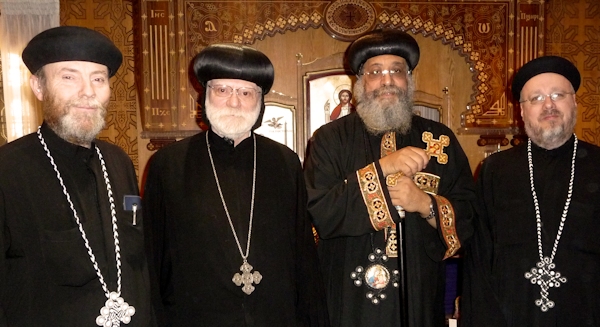
I have been blessed by my own bishop, and by His Holiness Pope Tawadros to visit Egypt shortly. I will be serving Father Daoud Lamie at a conference, and recording a series of programmes to be broadcast on a variety of Coptic channels. This is the text of the first of these, introducing the series, which will describe and explain our Orthodox Faith.
================================================
[Take a look at Missionary Support in 2015]
In the name of the Father, and of the Son, and of the Holy Spirit. Amen.
Hello. My name is Father Peter
Farrington. I am a priest of the British Orthodox Church within the Coptic
Orthodox Patriarchate. Perhaps you have not heard of the British Orthodox
Church before? It is a small community of Orthodox Christians, with an English
bishop, Metropolitan Seraphim of Glastonbury, which was brought into union with
the Coptic Orthodox Patriarchate through the imaginative and gracious activity
of His Holiness Pope Shenouda III in 1994. The British Orthodox Church is
committed to Orthodox missionary service in the United Kingdom, where we are
sharing our Orthodox Faith with all those who live among us.
We worship in the English
language, and we are living proof that it is possible to be authentically
Western and European, while also preserving and experiencing a traditional
Orthodoxy.
Sunday, 28 December 2014
Letters from a Desert Place - 1

Dear Father Peter,
I wanted to send a short message to say how much I enjoyed meeting you yesterday. If it hadn't started raining so heavily I'm not sure I would have come into your Church. I've passed it many times of course, and I told you that I have had a vague interest in Orthodoxy for some years. But the door was open and I didn't have a coat, so I found myself in the middle of the Liturgy.
Sunday, 21 December 2014
Homily for the Sunday before Christmas

I would also like us to have in mind a passage from the reading of the Gospel today. It is found at the end of our lection and says..
And the child grew, and waxed strong in spirit, and was in the deserts till the day of his shewing unto Israel. (Luke 1:80)
Subscribe to:
Posts (Atom)